|
start
>
6. Nutrient Gains and Losses
>
6.2 Nutrient Sinks (Losses)
>
6.2.2 Leaching
|
 back
forward
back
forward 
|
|
|
|
|
The leaching of nutrients (i.e., movement
with soil water below the root zone or into
groundwater) depends on:
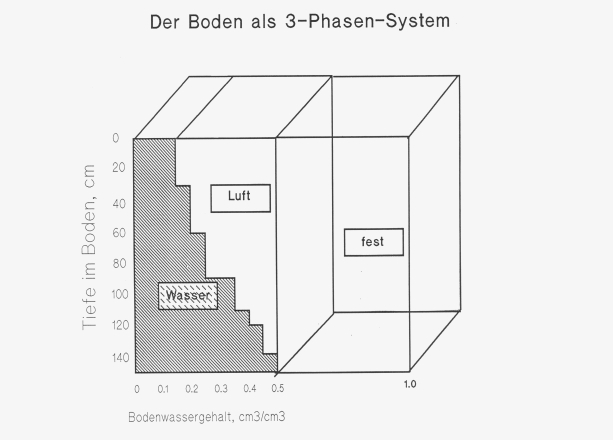
- Water-holding capacity: A soil with
high water retention (e.g., high clay or organic matter
content) holds more water against gravity, reducing deep drainage and thus leaching potential.
- Sorption/Buffering: Nutrients strongly
adsorbed to soil particles (e.g., phosphate, potassium to
clay) are much less prone to leaching than highly mobile anions in solution (e.g., nitrate,
chloride).
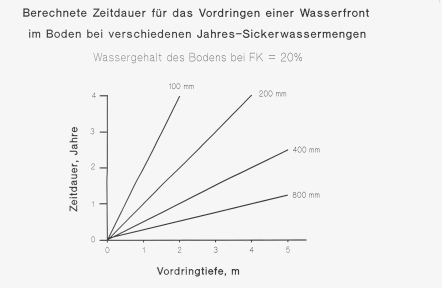
- Net percolation: The amount of water
draining beyond the root zone. High rainfall or irrigation
exceeding evapotranspiration and soil storage leads to high percolation, driving leaching.
|
|
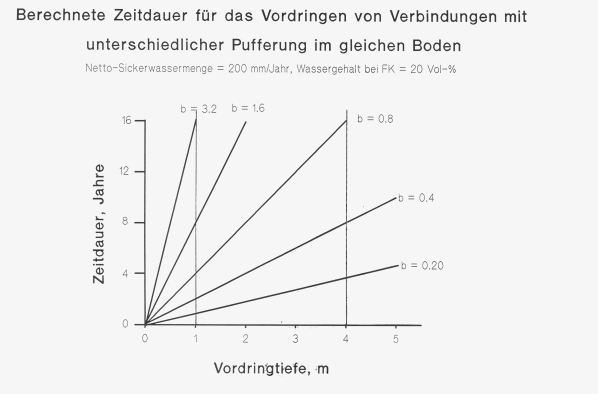
Buffering capacity (b) indicates the extent
of interaction between ions in solution
and ions on the solid phase. Mobility (M) is inversely proportional to buffering
capacity.,
M=1/b
A compound with a buffering capacity (b) of 2 (e.g., calcium) is displaced by 0.5
cm per 1 cm of
net percolation (=1/2). A compound with a buffering capacity of 10 (e.g., phosphate) is displaced by
0.1 cm (=1/10).
|
|
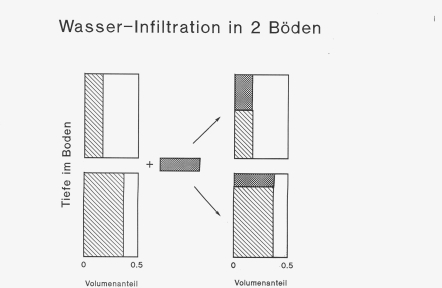
The water percolation through soil is inversely proportional to the water-holding
capacity of the soil.
- High water-holding capacity (e.g.,
in clayey or organic- rich soils) means the soil can retain
more water against gravity. This results in lower percolation rates, as more water is stored
within the root zone.
- Low water-holding capacity (e.g.,
in sandy soils) means the soil retains less water, leading to
higher percolation rates, as water drains more quickly beyond the root zone.
|
|
- Precipitation or Irrigation adds
water to the soil.
- Water first satisfies soil water
deficit and evapotranspiration (water used by plants and lost to
evaporation).
- Any excess water beyond what the
soil can hold and plants can use becomes net percolation,
moving downward through the soil profile.
- This percolating water carries soluble
nutrients (especially nitrate, sulfate, chloride) with it,
causing leaching when they move below the root zone.
Not all precipitation causes leaching. Only water exceeding the soil's field capacity
and plant
demand leads to net percolation.
Heavy, intense rainfall is more likely to cause leaching than the same total amount
of water applied
gradually, as it exceeds the soil's infiltration and storage capacity more quickly.
|
|
|
|
|