In this context, "nutrient requirement" refers to the amount of nutrient
needed to produce the plants
from which the harvested product (here used synonymously with "yield") is taken.
The nutrient requirement of the shoot and root is determined by the biomass produced
over a given
period (e.g., day, week, growing season) (in units such as g or kg) and the nutrient element
concentration (e.g., mg/kg, g/kg). Data in the literature is usually expressed per production area
(hectare, m²) or per individual plant. Typically, only figures for the shoot are available; exceptions are
root crops like carrots, sugar beets, and red beets.
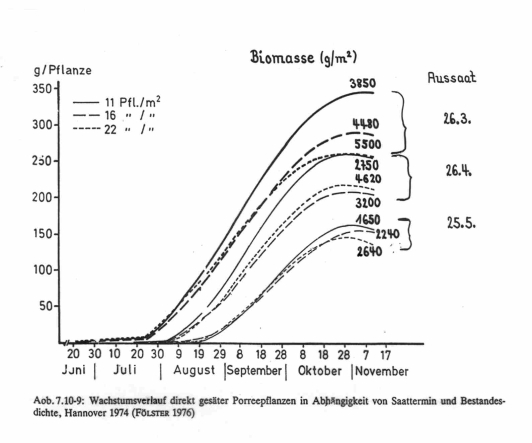
The figure below shows the temporal progression of shoot mass formation in leek, depending
on
sowing date and planting density. In this figure, the measured points are replaced by regression
curves — in general, biomass formation and nutrient uptake are determined through successive
harvests.
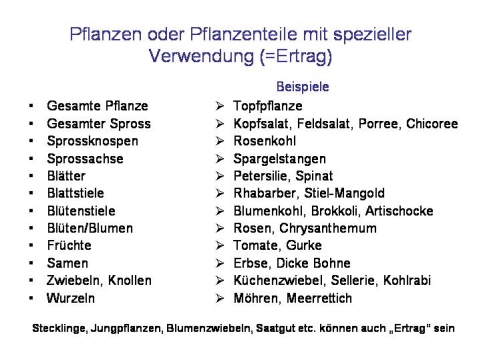
A complicating factor for many horticultural products is that a wide variety of plant
parts and organs
can constitute the harvested yield — while the "residual plant" must always be
co- produced (see
example in the illustration below).
Therefore, specifying the total nutrient
requirement includes the requirement of the
harvested product and that of the "residual" plant (exceptions: whole plants such as
Cyclamen, trees, seedlings). Both the total amount of nutrient the plants need to
reach the production target and the temporal sequence of this requirement are
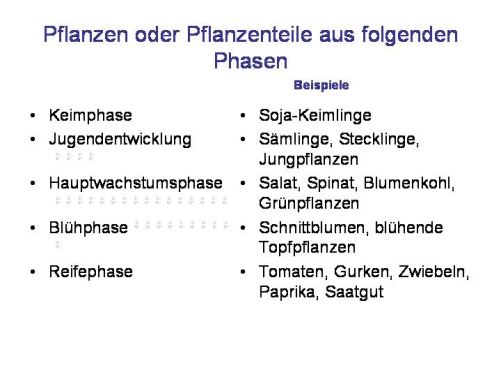
significant. The latter arises, at least in part, from the fact that plants or plant parts
can be harvested at different growth stages (see examples in the figure below).
It makes sense to divide the total nutrient requirement
- into the portion that is not harvested
and remains at the production site, and
- into the portion that leaves the
production site with the harvested product
as it allows an estimate of which nutrient gains are possible by reintroducing them
into the nutrient
cycle. These must be considered in fertilization measures for the following crop.
Please note:
- The total requirement is rarely identical
to the nutrient removal from the production area.
- The total nutrient requirement of
a plant is rarely identical to the fertilizer requirement (see the
topic area Sources/Sinks).
- Stating the total requirement says
little about the temporal pattern of demand and nutrient
uptake.
- The total amount of nutrient taken
up by a plant is not necessarily identical to the nutrient
requirement.
For determining the nutrient requirement (and ultimately the fertilizer amount),
it is very
important to realistically estimate the yield.