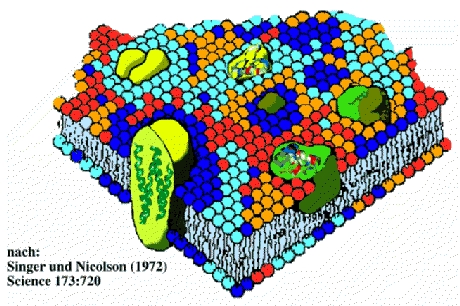
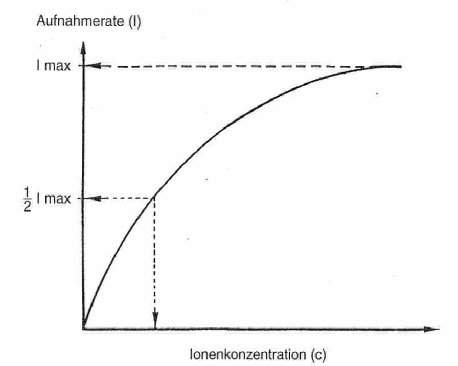
Plasma membranes contain ion channels (macromolecular pores). These are passive transport
systems driven by electrochemical potential gradients. Ion channels can transport 10⁶ ions/s,
whereas ATPases transport 200–600 ions/s.
These pores are water-filled and exhibit low ion selectivity. Well-known examples
include the
potassium channels in the plasma membrane of guard cells. Ion channels can also exist for Fe,
Mn, Zn, Cu, and Ni.
The primary function of these channels is likely osmoregulation, and they are mostly
in a closed
state.
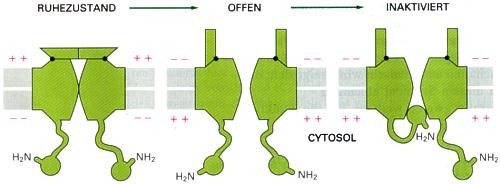
Ionenkanal schematisch.
Quelle: http://at22.bphys.uni-
linz.ac.at/bioph/teach/biophy/biophy4.htm
Co-Transport (Symport)
All co-transport mechanisms consume energy. Ions are bound to protons that are generated
by a
proton pump. It is considered symport when protons and ions are transported in the same
direction—this is the case for most anions. Antiport occurs when the proton and ion are
transported in opposite directions.