What constitutes the health problem?
It arises from the presence of nitrite (NO₂⁻ anion) in food. This
nitrite can:
- In babies, block the blood's ability
to carry oxygen, leading to "blue-baby syndrome." However,
only a few such cases have been reported.
- Be converted into nitrosamines in
the mouth and stomach of certain individuals; nitrosamines
have been identified as carcinogenic in animal experiments.
Where does this nitrite come from?
Nitrite occurs only to a limited extent freely in nature, as it is typically an intermediate
stage in the
conversion of nitrate. Sources include:
- A component of curing salt (potassium
and sodium nitrite).
- A product of nitrate reduction in
plant tissue under unfavorable conditions (e.g., dense
packaging leading to anaerobic conditions, high temperature).
- A product of nitrate reduction in
the human body (a high pH is a prerequisite, occurring in the
sick and in infants).
What are the sources of nitrate in the human diet, and what is their significance?
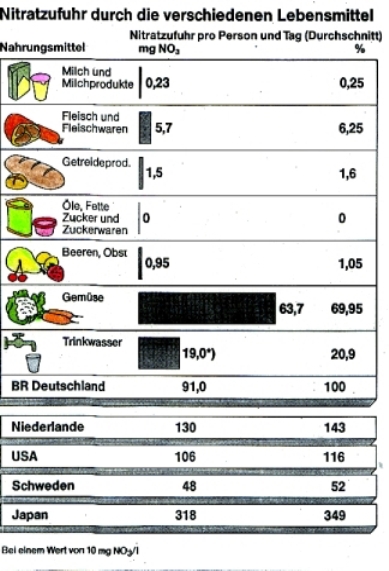
From the figure below, it becomes clear that vegetables and drinking water by far
constitute the
largest proportion of nitrate intake.
Therefore, it seems important:
To limit the nitrate content in vegetables wherever possible, particularly in
the diet of vulnerable
groups (e.g., through limits for dietetic vegetables and baby food). Possible techniques include:
reduced nitrogen fertilizer application, supplying plants with ammonium, monitoring and potentially
rejecting specific batches, washing processes during food processing, and blending.
To limit the nitrate content in drinking water. The current limit is 50 mg NO3
per liter (which
corresponds to how many ppm of NO3-N?). These limits are generally adhered to. However, there
have been and continue to be exceptions:
- In areas of very intensive livestock
farming with large quantities of slurry,
- After grassland is plowed up,
- Following legume cultivation,
- After heavy rainfall, localized leaching
events can occur in the landscape ("hot spots").
This is more likely the lighter the soil texture is. This contaminates the groundwater.
However, scientific studies clearly show that the life expectancy for groups of people
who consume
large quantities of vegetables (and fruit) is higher. The classic example is Japanese women, who
have a very high average life expectancy despite a very high consumption of vegetables.
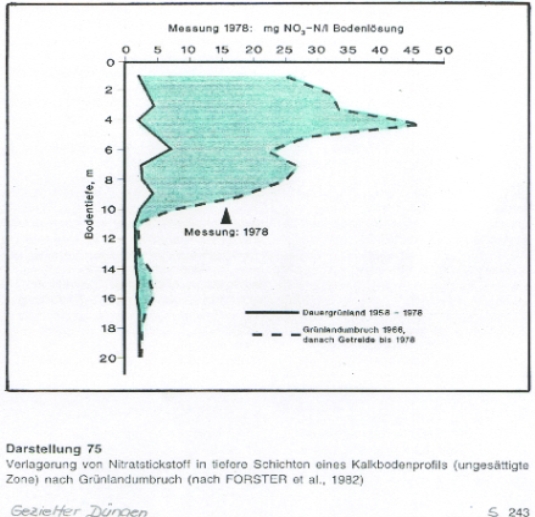
The figure below shows an example of the change in soil water concentration after
grassland is
plowed up.
What is water used for in a private household? Where does this water come
from?
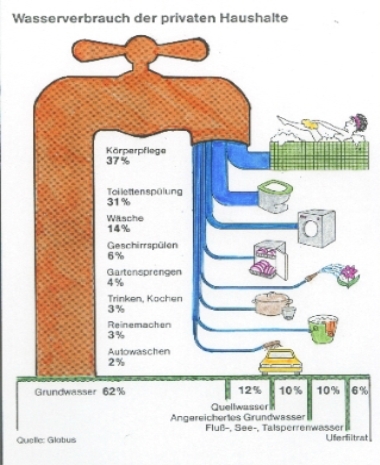
The figure above shows that food preparation accounts for only a very small portion
of a household's
water consumption. Approximately two-thirds of this water comes from groundwater.
My opinion: It is actually absurd to purify 100% of wastewater to drinking water quality
in treatment
plants when only 3% is used for food purposes.
Further problems associated with nitrogen:
- Denitrification and the threat to
the ozone layer by N2O.
- Production of ammonium in livestock
facilities and wastewater treatment plants.
- Acidification of soils and damage
to trees