The objective of applying soil/substrate analysis is to deduce, from the amount of
a nutrient
extracted from the soil/substrate:
- how high the future nutrient supply
to the plants is likely to be, and
- whether and to what extent there
is a fertilizer requirement.
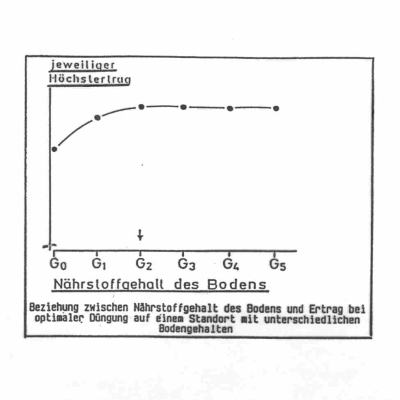
The basis is the assumption that the relationship shown below exists between the soil/substrate
content (G) of an extractable nutrient element and the plant yield. This statistical relationship is
established under practical, realistic conditions:
- for field crops, in field trials,
- for potted plants, in container/pot
experiments,
- for [...], in [...]
These statistical relations are only valid under non- experimental conditions if nutrient
supply is the
dominant factor influencin yield. Accordingly, the figure below illustrates that plant yield increases
as the soil contains more nutrients, leading to improved plant nutrition (see also the Laws of Yield).
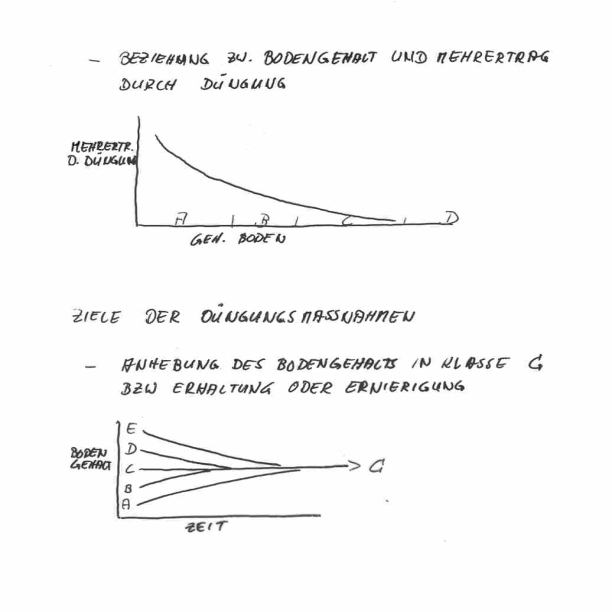
Put the other way around: The yield increase expected from fertilization is higher,
the lower the soil
nutrient content is (see figure below).
From these relationships, the following conclusions are drawn for field soils:
- There is a specific content of an
extractable nutrient in the soil that is sufficient to achieve the
production target (maximum yield?) under all realistic environmental and cultivation conditions.
This level is by definition classified as content class C.
- On soils with a nutrient content
lower than class C, a yield increase through fertilization can be
expected under certain conditions. Furthermore, the soil should be raised to content class C
through fertilization in the long term. The required fertilizer amounts are higher for content class
A than for content class B.
- On soils with a nutrient content
higher than class C, the soil should be depleted down to the
level of class C through reduced fertilization.
- To validate these assumptions, a
precise calibration of the extracted nutrient amounts against
yields from field trials is necessary.
Please note: Soil analysis only works if a validated and calibrated relationship exists
between the
amount of nutrient extracted by the chosen laboratory method and the actual nutrient availability for
the plants under specific local conditions (soil type, climate, crop). Without this crucial calibration,
the analysis result remains a mere number without reliable predictive power for fertilizer
requirements. Therefore, "new" methods of soil analysis and derived fertilizer recommendations
must be experimentally validated if they are used under conditions that were not included in the
original research.