|
|
start
>
8. How to Change Plant Nutrient Status
>
8.2 Direct Measures
>
8.2.1 Solid
|
 back
forward
back
forward 
|
|
|
|
|
In open field cultivation, the most widely used systems are:
- Single application of the total fertilizer
amount, and
- Base dressing followed by top dressing
(side dressing)
using solid, usually granular fertilizers. The use of slow-release fertilizers is
limited to special cases
due to their high cost relative to their benefit.
In contrast, fertilizing only a limited portion of the rootable soil/substrate volume
is of secondary
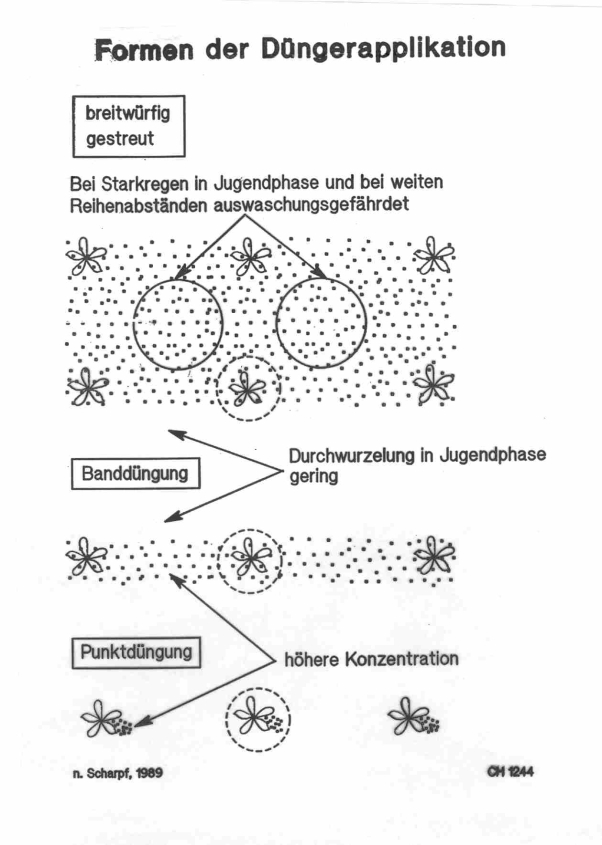
importance. However, localized fertilization (e.g., banding, spot placement) remains a topic of
professional interest, as certain problems could potentially be solved using this method
|
|
Open Field: The standard fertilization procedure in open field cultivation is the
uniform distribution of
fertilizer on the soil surface, followed by more or less intensive incorporation into the soil.
Potting Substrate: This is either pre-fertilized by peat/substrate manufacturers with
a base nutrient
charge, or the base fertilizer is mixed in on-site at the nursery/greenhouse operation |
|
Solid fertilizers constitute by far the largest share of commercial fertilizers.
Beyond the total nutrient content of a fertilizer, the chemical form and solubility
of the nutrient are
crucial criteria for its effectiveness after application. This is because, for a given soil water content,
it determines:
- How quickly and what quantities of
the applied nutrient dissolve in the soil water (example:
phosphate).
- Whether transformation processes
are required before the plant can take up the nutrient
(example: urea).
- Whether these nutrient quantities
are sorbed to soil particles or not (keyword: cations/anions),
become spatially accessible to the root (keywords: diffusion, mass flow), or can be leached
within the soil profile (keyword: rooting depth).
Since nutrient elements are packaged and offered by various manufacturers and distributors
as
single-nutrient fertilizers, compound fertilizers, or mixtures with trace elements, the selection is
vast. The question of choosing the appropriate fertilizer raises a whole series of further questions
that must be answered before a list of alternatives can be drawn up. These relate to:
- The application technology available
on the farm or accessible elsewhere. (e.g., if only a
centrifugal spreader is available, applying blended single-nutrient fertilizers may not be
advisable due to risk of segregation).
- The farm's strategy regarding fertilization
across the crop rotation (practicable only for large
farms with large, uniformly managed fields). For example:
Farm #1 might apply
P and K only once every x years to the most sensitive crop, but apply
N to every crop.
Farm #2 might have
decided to replace the P and K removed by the previous crop with each
fertilization event and apply N to the current crop.
- The necessity to use fast-soluble
compounds to secure yields. This can lead to the use of
triple superphosphate in one case, and partially acidulated rock phosphate in another.
|
|
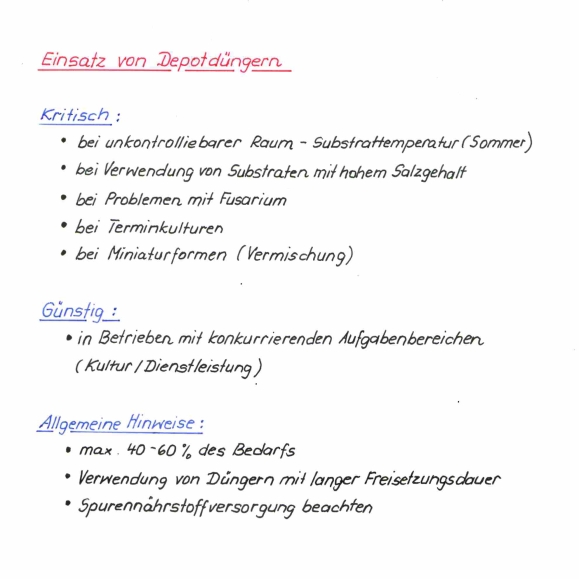
Slow-release fertilizers have a potential advantage over soluble salts that works
in several ways:
- The entire (often high) nutrient
quantity can be applied in a single application.
- Saves labor time due to one-time
application.
- Avoids high nutrient concentrations
in the soil/substrate for sensitive and/or young plants,
thereby reducing the risk of nutrient leaching.
Prerequisites for realizing these advantages:
- The fertilizer must release nutrients
in a "demand-oriented" manner.
- Nutrients in the fertilizer must
be bound in a way that allows them to gradually enter the soil
solution.
- The formulation of the fertilizer
must not pose ecological risks.
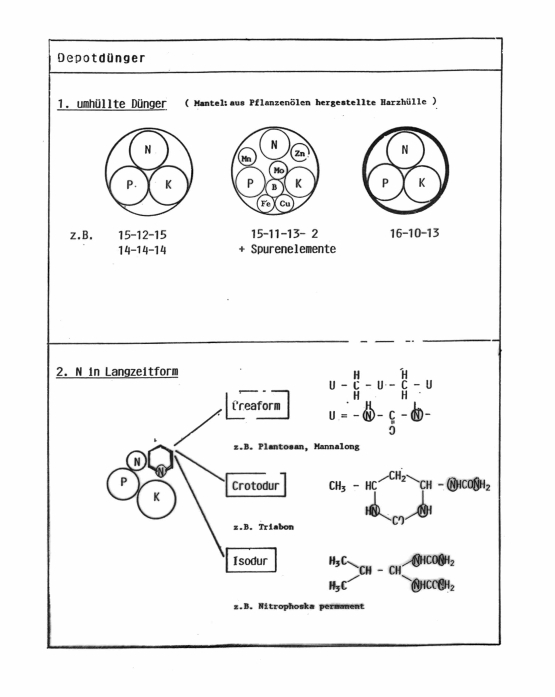
Various pathways, which can also be combined, are used to slow nutrient release and
achieve
desired product properties (and the industry does this):
- Physical Principle: Coating of soluble
salts.
The coating, made
of polymer or natural compounds (waxes, etc.), slows the dissolution of
the salts in the fertilizer granule and their diffusion into the surrounding soil. By choosing the
thickness and chemical composition of the coating, the duration of effectiveness can be
influenced, offering fertilizers of the "3-month, 6-month... type," although the release
duration still depends significantly on temperature. The most widely used fertilizer of this
type (worldwide) is sulfur-coated urea (SCU). Its effectiveness largely depends on the quality
of the sulfur coat, which often cracks or breaks, losing its function.
- Chemical Principle: Polymerization
of urea-containing compounds.
Examples include
urea-formaldehyde (Ureaform-N), crotonylidene diurea (Crotodur), and
isobutylidene diurea (Isodur). The release rate depends on moisture, temperature, and
particle size (for Isodur, also on soil pH).
- Physico-Chemical Principle: Ion Exchange.
Synthetic resin
beads with ion exchange sites are loaded with nutrients and used (primarily)
in hydroponic systems. Nutrients are released from the resin in exchange for ions in the
irrigation water—thus, it only works with water containing salts, not with distilled water.
Whether and which controlled-release fertilizer can/should be used instead of soluble
salts
depends on:
- Labor-management considerations
- Cost-benefit considerations (input
vs. effect)
- The sensitivity of the crop
- The temporal pattern of the plant's
nutrient demand in relation to the fertilizer's release
rate.
|
|
Primary Goals & Rationale
- Increase Nutrient Use Efficiency
(NUE): Places nutrients where roots can access them
immediately, minimizing fixation, immobilization, or leaching.
- Reduce Fertilizer Inputs:
Lower total amounts can be used compared to broadcasting.
- Overcome Soil Constraints:
Effective in soils with high phosphorus-fixing capacity, low pH, or
poor nutrient mobility.
- Stimulate Early Root
Growth: Encourages root proliferation in the fertilized zone, leading to
better crop establishment.
- Avoid Seed Damage: Prevents
salt injury or ammonia toxicity near germinating seeds by
keeping fertilizer at a safe distance.
Common Placement Methods
Banding:
Pop-Up/Seed-Placed:
A small amount of fertilizer is placed in direct contact with the
seed. Used only with safe, low-salt-index fertilizers (e.g., some MAP/DAP in small
doses). High risk of germination damage if not managed correctly.
Side-Dressing (2x2
Placement): A band of fertilizer is placed 2 inches to the side and
2 inches below the seed at planting. This is the gold standard for starter fertilizer
application for row crops (corn, cotton, sugar beet). It provides readily available
nutrients without seed burn.
Deep Banding: Placing
fertilizer (especially P, K, S) 6-12 inches deep, often in fall or
before planting, to place it in a moist soil layer for root access later in the season.
Common in conservation tillage systems.
Hilling or Hill
Placement:
Common in vegetable
production (e.g., potatoes, tomatoes). Fertilizer is placed in
the hill or mound where the plant is set.
Pocket or Spot Placement:
Used in perennial
crops (orchards, vineyards), forestry, or with widely spaced plants.
Fertilizer is placed in holes or pits near individual plants.
Fertigation with
Solid Dissolvable Fertilizers (Granular/Urea):
Technically not
a solid application at the end point, but specialized solid fertilizers
are dissolved in water and applied via irrigation systems (drip/sprinkler) for localized
liquid delivery.
Types of Fertilizers Suited for Localized Application
- High Analysis Granular Fertilizers:
MAP (Monoammonium Phosphate), DAP (Diammonium
Phosphate), TSP (Triple Superphosphate), Urea, MOP (Muriate of Potash
- Controlled-Release or Slow-Release
Fertilizers (CRFs/SRFs): Polymer-coated urea (PCU),
sulfur-coated urea (SCU). Ideal for localized placement as they provide a long-term nutrient
source in the root zone.
- Micronutrient Granules: Specific
formulations of Zn, B, Mn, etc., can be band-applied to correct
deficiencies.
Equipment Used
- Planter-Mounted Fertilizer Attachments:
Modern row-crop planters have dedicated units for
precise 2x2 placement.
- Deep Banding Rigs: Toolbars with
knifes or shanks that place fertilizer at depth.
- Side-Dress Applicators: Machines
that apply fertilizer to the side of established crop rows.
- Manual Tools: Hoes, jab planters,
or specialized tools for small-scale or horticultural use.
Advantages
- Higher Efficiency: Especially for
immobile nutrients like Phosphorus (P), Zinc (Zn), and Iron
(Fe).
- Reduced Losses: Less exposure to
runoff, erosion, and volatilization.
- Lower Fixation: In high-P-fixing
soils, banding reduces the soil surface area the fertilizer
contacts, minimizing fixation.
- Faster Early Growth: Provides a "starter
effect" for seedlings.
- Complements Conservation Tillage:
Efficient nutrient placement in no-till/minimum-till systems
where mixing is limited.
Disadvantages & Challenges
- Higher Equipment Cost: Requires specialized,
often more expensive, application machinery.
- Increased Skill Requirement: Precise
calibration and operation are crucial to avoid root damage
or inefficient placement.
- Risk of Root Burn: If bands are too
concentrated or too close to seeds/roots.
- Potential for Nutrient Stratification:
Nutrients remain only in the banded zones, which may not
be optimal if root systems do not fully explore them.
- Not Suitable for All Nutrients: Mobile
nutrients like Nitrate-N (NO₃⁻) are better managed with
split applications or fertigation, as they move with water.
Best Practices
- Know Your Soil: Understand pH, fixation
capacity, and nutrient mobility.
- Follow the 4R's:
Right Source: Use
fertilizers suitable for banding (e.g., low salt index for seed placement).
Right Rate: Adjust
rates based on soil test and placement method (band rates are often 50-
70% of broadcast recommendations for P).
Right Time: Usually
at planting for the starter effect.
Right Place: Precise
2x2 placement is generally safer and more effective than seed-placed.
- Calibrate Equipment: Ensure accurate
application rates and placement depth/spacing.
- Monitor Salinity: Avoid placing high
rates of salts (e.g., KCl, Urea) in direct seed contact.
Some systemic considerations
By fertilizing a limited portion of the rootable soil volume, the goal is to create
a high nutrient
concentration in the soil solution of precisely that area. This allows for influencing processes within
this soil volume, such as:
- Affecting microbial activity. Example:
Reduced nitrification of ammonium when applying large
tablets of ammonium salts (CULTAN method, see paragraph Mscellaneous Information) or
ammonium solutions.
- Stimulating root growth (observed
for N and P) or even reducing it (at very high concentrations).
- Reducing the buffering capacity for
nutrients with low mobility to such an extent that the
solution concentration, and thus the availability of the ions, increases significantly.
Whether and for how long localized fertilization has a positive effect on plant growth
depends on:
- How long the positive effect of localization
on physico-chemical and biological processes lasts.
- Whether and for how long the roots
in contact with the fertilized soil volume can sustain the
supply for the entire plant (keyword: lifespan of a root segment).
In a strict sense, there is an optimal soil volume to be fertilized for every situation.
However:
- The smaller this volume is, the lower
the proportion of roots likely in contact with the nutrient,
and the sooner the positive effect should diminish (if found at all, it is typically observed in
plants during early development, consistent with the above reasoning).
- If fertilizer cost is not a predominant
concern, enriching as large and densely rooted a soil
volume as possible is preferable.
|
|
|
|
|
|