Key to Nutrient Deficiency and Toxicity Symptoms
This guide provides a systematic approach to diagnosing plant disorders related to
nutrient
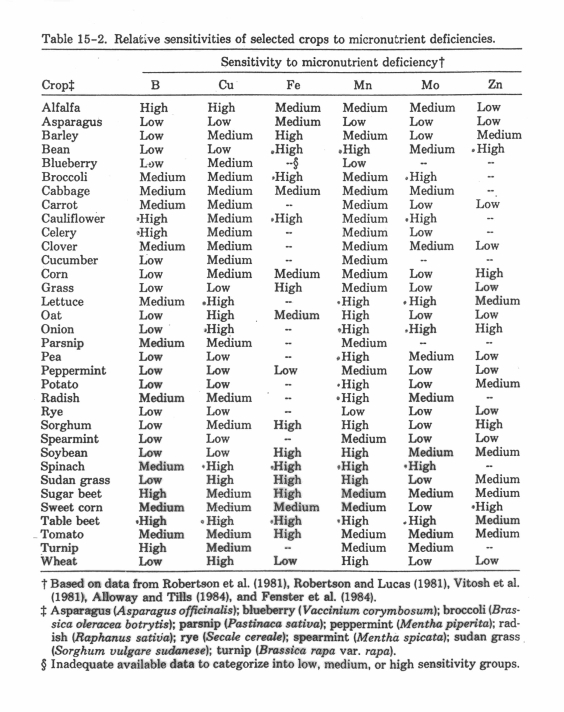
imbalance. Symptoms can vary widely depending on plant species (see Table at the end of the
paragraph), growth stage, and environmental conditions, but general principles apply.
1. Visual Symptom Analysis: Primary Observations
A. Location on Plant:
Older/Lower Leaves:
Symptoms appearing first on mature leaves typically indicate
mobile nutrient issues. The plant translocates these nutrients to support new growth.
Deficiency Examples:
Nitrogen (N), Phosphorus (P), Potassium (K),
Magnesium (Mg).
Toxicity Possibility:
Molybdenum (Mo).
Newer/Upper Leaves
& Growing Points: Symptoms appearing first on young leaves,
terminal buds, or emerging foliage suggest immobile nutrient issues. These elements
cannot be easily relocated from older tissues.
Deficiency Examples:
Calcium (Ca), Boron (B), Iron (Fe), Copper (Cu),
Sulfur (S), Manganese (Mn), Zinc (Zn).
Toxicity Common:
Boron (B), Copper (Cu), Manganese (Mn).
B. Nature of Symptom:
Chlorosis (Yellowing):
Interveinal: Yellowing
between veins while veins remain green. Classic sign
of Mg, Fe, Mn, or Zn deficiency.
Uniform: General
yellowing of the entire leaf, often starting with N, S
deficiency, or sometimes Mo.
Necrosis (Tissue
Death):
Marginal/Scorching:
Browning/death at leaf edges and tips. Strong indicator
of K deficiency or salt/B toxicity.
Spots/Patches: Discrete
dead areas, which can indicate Ca deficiency
(e.g., blossom end rot) or toxicity of various elements.
Stunting & Malformation:
Rosetting/Short
Internodes: Clustered, small leaves. Key sign of Zn or Cu
deficiency.
Distorted New Growth:
Crinkled, misshapen, or brittle young
leaves/meristems. Characteristic of Ca or B deficiency, or B toxicity.
Abnormal Coloration:
Purpling/Reddening:
Anthocyanin accumulation, often due to P deficiency
(especially under cool conditions) or sometimes Mg.
Bronzing/Browning:
Can indicate Mn toxicity or K deficiency.
2. Key Diagnostic Questions (Checklist)
- Where did symptoms first appear? (Old
vs. new growth?)
- What is the pattern of discoloration?
(Uniform, interveinal, marginal?)
- Is there necrosis? What is its pattern?
- Is overall growth stunted or distorted?
- What is the plant species? (Know its
specific sensitivities.)
- What are the soil/potting medium conditions?
- pH (Most critical! Affects all nutrient
availability)
- Texture (Drainage, water retention)
- Recent fertilization history
- What are the environmental conditions?
- Temperature & Light
- Watering regime (Over/underwatering
mimics deficiency)
3. Nutrient-Specific Symptom Summaries
|
Nutrient
|
Deficiency
Key Symptoms
|
Toxicity/Excess
Key Symptoms
|
Mobility in
Plant
|
|
Nitrogen
(N)
|
Uniform pale green/yellowing
of older
leaves, stunting.
|
Dark green, succulent growth;
delayed
maturity; can increase disease susceptibility.
|
Mobile
|
|
Phosphorus
(P)
|
Dark green or purple/reddish older
leaves,
stunted growth.
|
Rare.
Can induce Zn, Fe, or Cu deficiency.
|
Mobile
|
|
Potassium
(K)
|
Chlorosis & necrosis
on margins/tips of older
leaves ("scorching").
|
Rare.
Can cause Mg or Ca deficiency.
|
Mobile
|
|
Calcium
(Ca)
|
New leaves distorted,
hooked; necrotic
spots; blossom end rot.
|
Rare.
Can cause Mg or K deficiency.
|
Immobile
|
|
Magnesium
(Mg)
|
Interveinal chlorosis
on older leaves, veins
stay green.
|
Rare.
|
Mobile
|
|
Sulfur
(S)
|
Uniform pale green/yellowing
of new leaves
(resembles N but in young tissue).
|
Foliar
burn, reduced growth.
|
Relatively
Immobile
|
|
Iron
(Fe)
|
Severe interveinal chlorosis
on new leaves,
veins stay bright green.
|
Rare
in most soils. Can cause bronzing, spots.
|
Immobile
|
|
Manganese
(Mn)
|
Interveinal chlorosis
on new leaves (milder
than Fe), may have necrotic spots.
|
Dark spots/patches on older
leaves
("manganese toxicity"), chlorosis.
|
Immobile
|
|
Zinc
(Zn)
|
Small, narrow, clustered
leaves (rosette),
interveinal chlorosis.
|
Stunting,
Fe deficiency chlorosis.
|
Immobile
|
|
Copper
(Cu)
|
Young leaves dark green,
wilted, twisted;
dieback of tips.
|
Reduced
root growth, Fe deficiency symptoms.
|
Immobile
|
|
Boron
(B)
|
Death of growing points,
brittle, distorted
new growth, hollow stems.
|
Yellowing/necrosis of
leaf tips/margins on
older leaves.
|
Immobile
|
|
Molybdenum
(Mo)
|
Interveinal chlorosis
on older/middle
leaves, leaf margin curling (e.g., "whiptail"
in cauliflower).
|
Rare.
May appear as Cu deficiency.
|
Mobile
|
4. Critical Consideration: The pH Factor
Soil/substrate pH
is the master variable controlling nutrient availability. Many "deficiencies"
are actually nutrient lock- ups due to incorrect pH.
Acidic Soils (Low
pH): Increase availability of Mn, Fe, Al, Cu, Zn. Can lead to toxicities of
these and induce Ca, Mg, Mo, P deficiency.
Alkaline Soils (High
pH): Decrease availability of Fe, Mn, Zn, Cu, B. Often causes
deficiency of these, especially Fe chlorosis.
First step in
diagnosis: Always test or estimate the pH.
5. Actionable Diagnostic Pathway
- Observe: Use Sections 1 & 2 to
characterize symptoms and context.
- Check pH: Rule out availability issues.
- Compare: Use the table in Section
3 to match symptoms, considering mobility.
- Confirm: If possible, use soil tests
and plant tissue analysis for definitive diagnosis. Visual
diagnosis is a critical first step but can be confounded by multiple stresses.
- Remediate: Apply targeted correction
(e.g., adjust pH, apply specific fertilizer) and monitor
plant response.
Disclaimer: This key provides general guidance. Always consider plant-specific
information and
confirm diagnoses with analytical testing where critical decisions (e.g., crop management, large-
scale treatment) are involved.
In the range of latent deficiency/excess, no symptoms are visible, yet
plants do not grow or
develop optimally. This condition can only be recognized through comparison or experience, as the
plant adjusts its growth rate to the supply rate: it grows just fast or slow enough so that the supply
rate sustains a tissue concentration sufficient to complete its life cycle. Symptoms appear when
the supply comes to a complete halt (sometimes only temporarily—is this what is meant by
“outgrowing deficiency” or “overcoming deficiency”?).
The table below shows the the sensitivities of a number of crops to micro nutrient
deficiencies
which may be expressed in symptoms